How Ice Damage Affects Shoreline
Structures Every Winter
The annual battle between ice and infrastructure along Ontario waterways costs millions in repairs and replacement
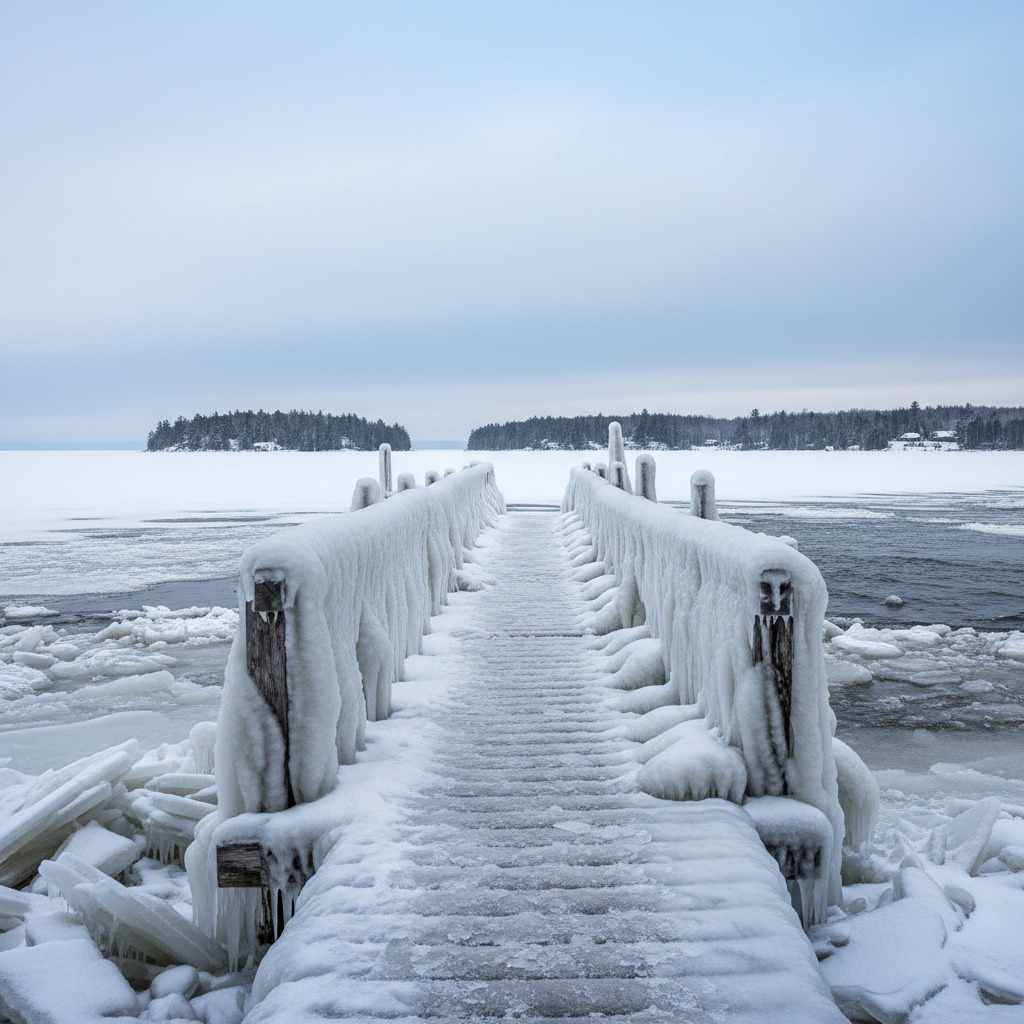
When spring arrives along Ontario shorelines, the retreating ice reveals the damage it has done. Dock sections shifted out of alignment. Steel piles bent at angles. Retaining wall stones displaced. Breakwater rocks scattered. Concrete caps cracked and lifted. Every winter, ice exerts forces on shoreline structures that would surprise most property owners, and every spring, the repair bills arrive.
Ice damage is one of the least glamorous but most costly challenges facing waterfront property owners and municipalities in Ontario. The forces involved are immense. Water expands by about nine percent when it freezes, and a sheet of ice expanding across a lake or river pushes against anything in its path with forces that can exceed tens of thousands of kilograms per linear metre. Structures that were not designed to withstand these forces, or that have weakened over years of repeated ice loading, fail in predictable and sometimes spectacular ways.
Types of Ice Damage
Ice damage to shoreline structures takes several forms, each driven by different physical processes. Ice thrust occurs when a large sheet of ice expands due to temperature changes and pushes horizontally against structures along the shore. On a large lake, the combined force of an expanding ice sheet can be enormous, capable of moving boulders, bending steel, and shoving concrete structures out of position. Ice thrust is most severe during mid-winter warm spells followed by refreezing, which causes the ice sheet to expand and contract repeatedly.
Ice jacking, also called frost heave, occurs when ice forms around piles, posts, or other vertical elements in the water and then lifts them as the ice sheet rises during spring breakup or water level fluctuations. A wooden dock post frozen into the ice can be lifted by several centimetres or more when the surrounding ice moves upward, and if the post does not settle back to its original position when the ice melts, the dock becomes unlevel and unstable over time. Repeated cycles of ice jacking can progressively lift piles out of the lake bottom.
Impact damage occurs when wind-driven ice floes collide with structures along exposed shorelines. During breakup, large slabs of ice can be driven ashore by strong winds, crashing into docks, seawalls, and anything else in their path. The kinetic energy of a moving ice floe can be devastating, and structures in the path of windblown ice during spring breakup are at serious risk.
Abrasion damage is a slower but persistent process. Ice grinding against concrete, steel, or wood surfaces wears away material over time, weakening structural elements and reducing their lifespan. Concrete surfaces exposed to ice abrasion develop a characteristic smooth, polished appearance and gradually lose mass. Steel piles in the ice zone can lose significant wall thickness over decades of ice abrasion.
Protecting Structures
The most effective protection against ice damage is to remove structures from the water before freeze-up. Floating docks and removable dock sections can be pulled onshore or stored in dry dock, eliminating their exposure to ice forces entirely. This is standard practice at many Ontario marinas and cottages, and it is the single best way to extend the life of dock systems.
For permanent structures that must remain in the water through winter, design is the primary defense. Piles can be designed with steel sleeves in the ice zone that resist abrasion and ice jacking. Retaining walls can be built with battered faces that allow ice to ride up rather than push against the wall. Breakwater designs that use sloped rather than vertical faces reduce ice thrust loads. Engineers who specialize in waterfront structures in cold climates understand these design principles, but not all structures are designed by specialists.
Ice shields and deflectors are used at some sites to redirect ice forces away from vulnerable structures. These can be as simple as angled timbers installed in front of piles or as complex as purpose-built steel deflectors anchored to the lakebed. Their effectiveness depends on proper placement and regular maintenance.
Bubbler systems, which circulate warm water from the lake bottom to the surface, can prevent ice from forming around specific structures. These systems are commonly used at marinas and commercial docks where the cost of the system is justified by the value of the infrastructure being protected. They are less common at residential properties due to cost and energy consumption, though some cottage owners use small bubblers to protect their permanent dock sections.
The Municipal Challenge
Municipalities along Ontario waterways face significant annual costs from ice damage to public infrastructure. Harbours, public docks, breakwaters, piers, and seawalls all require regular inspection and repair after each winter. The cumulative cost of ice damage to municipal waterfront infrastructure across Ontario runs into the tens of millions of dollars annually.
For many smaller municipalities, the cost of maintaining waterfront infrastructure to withstand ice forces is a constant budget pressure. Repairs are often deferred due to limited funds, which allows damage to accumulate and increases the eventual cost of restoration or replacement. Some municipalities have found that the cost of engineering ice-resistant replacement structures is beyond their capital budget capacity, leaving them dependent on emergency repairs that do not address the underlying vulnerability.
Climate Change Complications
The relationship between climate change and ice damage is not straightforward. Warmer winters are reducing the overall duration of ice cover on Ontario lakes and rivers, which might suggest less ice damage. However, the increased frequency of mid-winter thaw-freeze cycles can actually increase ice thrust forces by creating more expansion-contraction events. Reduced ice cover also means less protection from winter storms, exposing shoreline structures to wave action during months when they were historically shielded by ice.
The unpredictability of winter conditions under a changing climate makes it harder for property owners and municipalities to plan. A mild winter with thin ice may cause less damage than a winter with repeated freeze-thaw cycles. The old rules of thumb about when to remove docks and when to install ice protection may no longer be reliable.
For waterfront property owners, the practical lesson is straightforward: respect the ice. Remove what you can from the water before winter. Design what must stay to withstand the forces. Inspect everything in spring. And budget for the repairs that the ice will inevitably demand.
By Maren Falk, Environment Editor