Aging Infrastructure on the Waterfront
Is a Ticking Clock
The seawalls, piers, and water systems that Ontario waterfront communities depend on are deteriorating faster than they can be replaced
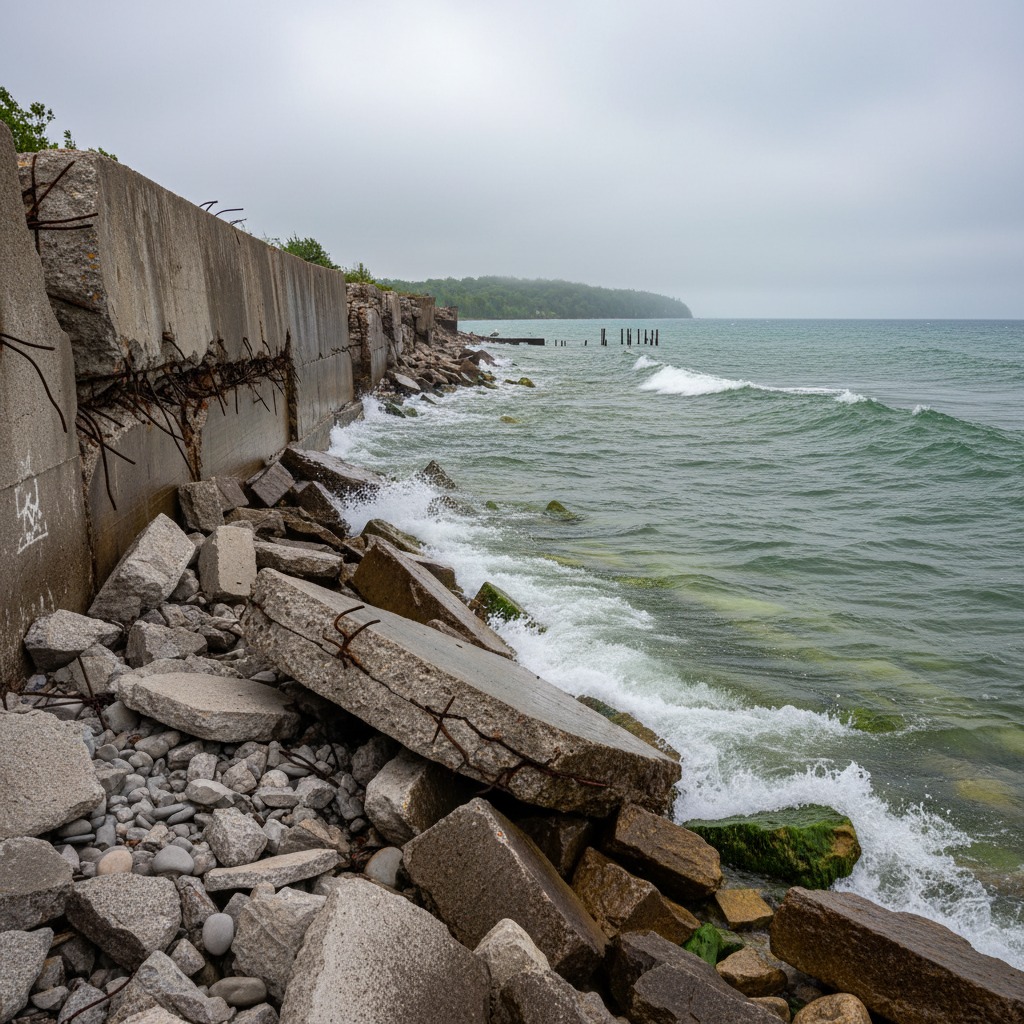
Walk along the public waterfront in almost any Ontario town with a harbour, a pier, or a seawall, and if you look closely, you will see the signs. Concrete spalling to reveal rusted rebar. Timber piles dark and soft with rot. Steel sheet piling corroded at the waterline. Stone walls bulging where backfill has shifted. These are the structures that protect the waterfront, that make harbours navigable, that keep the lake from flooding downtown. And many of them are reaching the end of their useful life.
Waterfront infrastructure in Ontario, much of it built in the 1950s through 1970s, is approaching or exceeding its designed lifespan. The concrete seawalls have a typical design life of 50 to 75 years. The timber piles that support docks and piers may last 25 to 40 years, depending on water conditions. Steel sheet piling corrodes at rates that vary with water chemistry but eventually fails. The clock is running on infrastructure that municipalities cannot afford to replace all at once but cannot afford to let fail.
The Scale of the Problem
Ontario has thousands of kilometres of publicly owned waterfront infrastructure, including harbour walls, breakwaters, piers, municipal docks, boat launches, seawalls, and boardwalks. Many of these structures were built with federal or provincial funding during the mid-20th century, when investment in waterfront infrastructure was a priority for economic development and flood protection. The municipalities that now own and maintain these structures often do not have the financial capacity to fund the repairs and replacements that are needed.
The situation is particularly acute for small municipalities that inherited major waterfront infrastructure. A town of a few thousand people may be responsible for a harbour wall that cost millions of dollars in today's terms to build and would cost even more to replace. The annual maintenance budget for the entire municipality may be a fraction of what a single major waterfront infrastructure replacement project would require.
Federal harbours transferred to local ownership under the Divestiture of Federal Harbours Program in the 1990s and 2000s represent a specific challenge. Many of these harbours were in poor condition at the time of transfer, and the municipalities that accepted them often underestimated the cost of ongoing maintenance and eventual replacement. Some municipalities are now facing infrastructure crises in harbours they cannot afford to fix and cannot afford to abandon.
The Consequences of Delay
Deferring maintenance and replacement of waterfront infrastructure is a false economy. Structures that are not maintained deteriorate faster, and the cost of repairs increases exponentially as damage progresses. A crack in a concrete seawall that could be repaired for a few thousand dollars when it first appears becomes a structural failure requiring hundreds of thousands of dollars to fix if it is ignored for a decade. The longer repairs are delayed, the more expensive the eventual bill.
Structural failures can be catastrophic. A collapsed seawall can flood adjacent properties and infrastructure. A failed breakwater exposes the harbour to storm damage. A deteriorated dock that gives way under a pedestrian or vehicle creates liability exposure for the municipality. These risks are not hypothetical. Structural failures at municipal waterfront facilities have occurred across Ontario, resulting in property damage, injury, and emergency spending that dwarfs the cost of preventive maintenance.
Beyond the risk of failure, deteriorating waterfront infrastructure undermines the economic vitality of the communities it serves. A harbour with crumbling walls and silted channels loses commercial and recreational traffic. A waterfront promenade that is closed due to structural concerns removes a community asset that supports tourism and quality of life. The visual impression of decaying infrastructure sends a signal to visitors and investors that the community is in decline.
Funding the Fix
The funding gap for waterfront infrastructure renewal in Ontario is substantial. Municipal infrastructure funding from the federal and provincial governments has increased in recent years through programs such as the Canada Community-Building Fund and the Ontario Community Infrastructure Fund, but waterfront structures often compete with roads, bridges, water systems, and other priorities for these limited dollars. Dedicated funding for waterfront infrastructure is rare.
Some municipalities have explored creative funding approaches, including special waterfront levies on property taxes, user fees for harbour and dock facilities, partnerships with private sector operators who invest in infrastructure in exchange for operating rights, and collaborative applications for federal infrastructure funding that pool multiple municipal projects. These approaches can help, but they are not sufficient to close the gap for the most expensive projects.
Asset management planning, which is now required of Ontario municipalities, provides a framework for understanding the condition, lifespan, and replacement cost of infrastructure assets and for planning financially for their renewal. Municipalities that include waterfront infrastructure in their asset management plans are better positioned to budget for maintenance and replacement over the long term and to make the case for external funding when needed.
Looking Forward
The waterfront infrastructure challenge is not going away. Climate change, which is producing more intense storms, higher water levels, and more freeze-thaw cycles, is accelerating the deterioration of existing structures and increasing the design requirements for replacements. The cost of construction continues to rise. And the demographic and economic pressures on waterfront communities are making this infrastructure more important, not less, to their future prosperity.
The communities that will fare best are those that take an honest look at the condition of their waterfront infrastructure, develop realistic plans and timelines for renewal, and invest in maintenance that extends the life of structures while replacement funding is assembled. Ignoring the problem until a structure fails is the most expensive and most dangerous option available. The clock is ticking, and the longer the delay, the bigger the bill.
By James Whitfield, Planning and Development Reporter