Phragmites: The Invasive Grass
Taking Over Ontario Shorelines
Dense stands of this aggressive reed are transforming wetlands, clogging beaches, and defying control efforts across the province
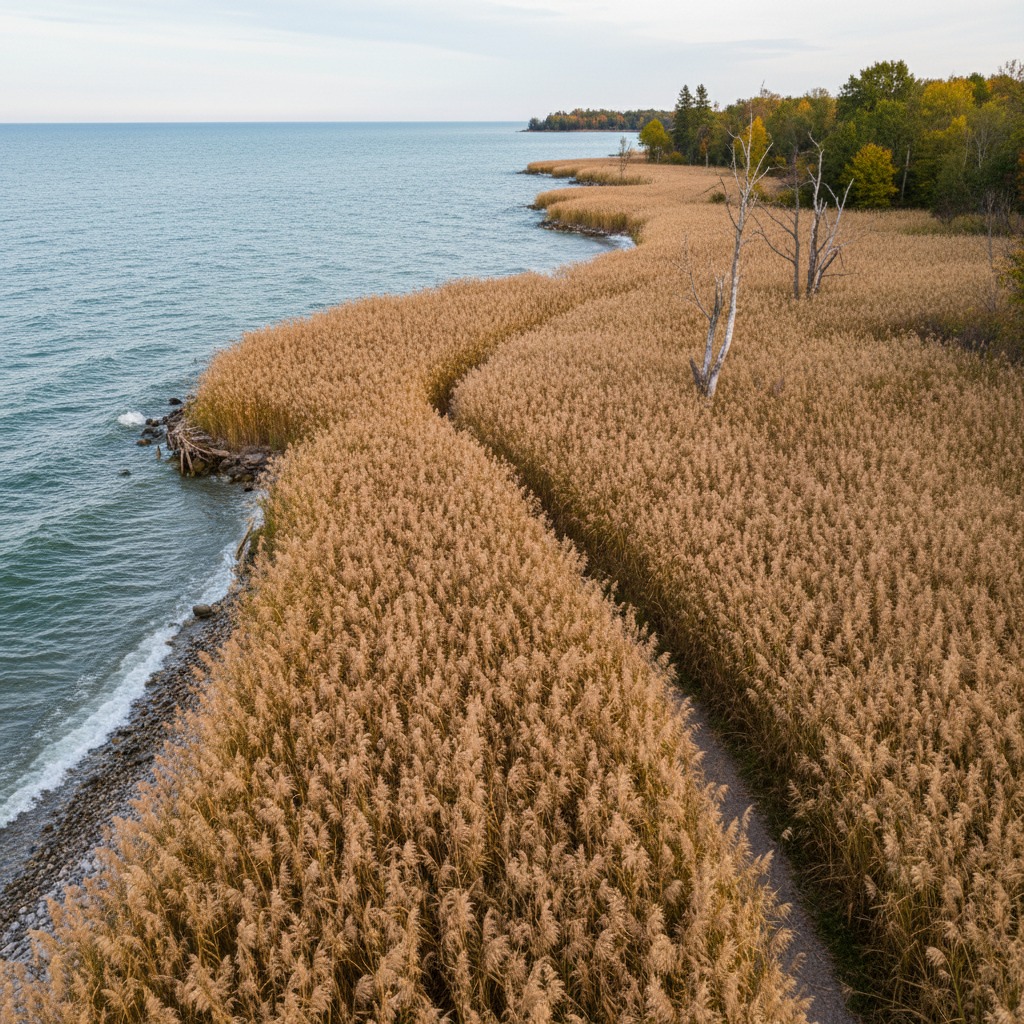
If you have driven along any highway in southern Ontario near a wetland, ditch, or lakeshore in the past decade, you have seen phragmites. Stands of this tall, feathery reed, sometimes reaching five metres in height, have become one of the most visible signs of ecological change across the province. What looks like a natural part of the landscape is actually an aggressive invader that is fundamentally transforming the wetlands and shorelines it colonizes.
European phragmites, formally known as Phragmites australis subspecies australis, is considered the most significant invasive plant species in Ontario. It has been listed as a restricted invasive species under Ontario's Invasive Species Act, meaning it is illegal to import, transport, or release it. Despite this designation and despite millions of dollars spent on control efforts, the species continues to spread, colonizing new sites and expanding within areas it has already reached.
How It Spreads
Phragmites spreads through both seeds and vegetative reproduction, and it is effective at both. A single stand can produce hundreds of thousands of seeds per year, which are dispersed by wind and water. But the primary mode of expansion is through an underground network of rhizomes, horizontal stems that grow outward from the parent plant and send up new shoots. A phragmites stand can expand its rhizome network by several metres per year, gradually displacing everything in its path.
Road construction and maintenance have been major vectors for phragmites spread. The species thrives in the disturbed soils along highway ditches, and construction equipment can transport rhizome fragments from infested sites to new locations. Once established in a ditch, phragmites can spread into adjacent wetlands, agricultural fields, and shoreline areas. The pattern of invasion across Ontario clearly follows the highway network, with infestations radiating outward from roadsides into surrounding landscapes.
Water level fluctuations also play a role. During periods of low water, exposed lakebed provides ideal conditions for phragmites establishment. Once a stand takes hold on the exposed lakebed, it can persist even when water levels rise, because the rhizome system can survive extended periods of flooding. This dynamic has contributed to phragmites colonization of coastal wetlands along the Great Lakes, particularly during the low-water period of the mid-2000s to early 2010s.
What It Does to Ecosystems
A phragmites invasion transforms a diverse wetland community into a monoculture. The dense stands shade out native plants, reduce habitat diversity, and alter the physical structure of the wetland. Where a healthy coastal marsh might support dozens of plant species, including cattails, bulrushes, sedges, and aquatic plants that together create a mosaic of open water and vegetation, a phragmites-dominated marsh is a uniform wall of reed with little structural variation.
The impacts on wildlife are significant. Studies have found that bird diversity and abundance decline in phragmites-dominated wetlands compared to native marsh. Many wetland-dependent bird species, including marsh wrens, Virginia rails, and least bitterns, avoid dense phragmites stands because the vegetation structure does not provide the mix of open water and emergent vegetation they need for nesting and foraging. Amphibians and reptiles are similarly affected, with reduced diversity in invaded areas.
Fish habitat is also impacted. Phragmites stands along shorelines can extend into shallow water, reducing access to spawning and nursery habitat. The dense root mats can alter water circulation patterns in nearshore areas, and the accumulation of dead phragmites stalks can smother substrates that fish depend on for spawning.
On beaches, phragmites colonization blocks access, reduces recreational value, and changes the visual character of the shoreline. Dense stands trap sand and organic material, building up the beach surface and changing the drainage patterns that maintain the open, sandy conditions that beachgoers and nesting shorebirds depend on.
Control Efforts
Controlling phragmites is difficult, expensive, and requires a sustained commitment. The species is extremely resilient, with a rhizome system that can extend two metres underground and survive most mechanical disturbance. Cutting alone is ineffective because the rhizomes simply regenerate new shoots. In most cases, effective control requires an integrated approach that combines multiple methods over multiple years.
The most effective control programs combine herbicide application with mechanical treatment and sometimes prescribed burning. Glyphosate-based herbicides applied to actively growing phragmites in late summer or early fall can kill the above-ground growth and damage the rhizome system. Follow-up cutting and removal of dead stalks allows native plants to recolonize. Prescribed burning, where site conditions and regulations permit, can reduce the accumulated thatch layer and create conditions that favour native species recovery.
In Ontario, some of the most intensive phragmites control efforts have focused on coastal areas along Lake Erie and Lake Huron, where large stands threaten ecologically significant wetlands and beaches. The Ontario Phragmites Working Group coordinates efforts among conservation authorities, municipalities, provincial agencies, and community groups. Local campaigns, such as those in the Long Point area and along the Lake Huron coast near Grand Bend, have achieved significant reductions in phragmites cover at priority sites.
However, the scale of the invasion continues to outpace the scale of control efforts. For every site where phragmites is beaten back, the species expands into new areas. The challenge is not a lack of knowledge about how to control it, but a lack of resources to apply that knowledge across the enormous area that is now infested.
Prevention and Monitoring
Prevention of new phragmites establishment is far more cost-effective than control of existing stands. Property owners along shorelines can help by learning to identify phragmites and reporting new occurrences to their local conservation authority. Early detection and rapid response to new stands, before the rhizome system becomes established, can prevent the multi-year, multi-thousand-dollar control efforts that are required once a stand is well entrenched.
Avoiding disturbance to soil near wetlands and shorelines reduces the risk of creating conditions that favour phragmites establishment. When soil disturbance is unavoidable, such as during construction, prompt revegetation with native species can help prevent phragmites from gaining a foothold.
The fight against phragmites is a long-term commitment. There is no quick fix and no single treatment that will eliminate the species from Ontario. But with sustained effort, strategic prioritization of control sites, and broad community engagement, it is possible to protect the most valuable wetlands and shorelines from the worst impacts of this relentless invader.
By Maren Falk, Environment Editor